Fingers hurt — should you keep playing? A pain chart
Most people who quit in the first three weeks do so because of fingertip pain. That pain is normal, and it passes. But some pain isn't normal, and that kind means you should stop. Here is a chart to tell them apart, and ways to get through it with less pain.
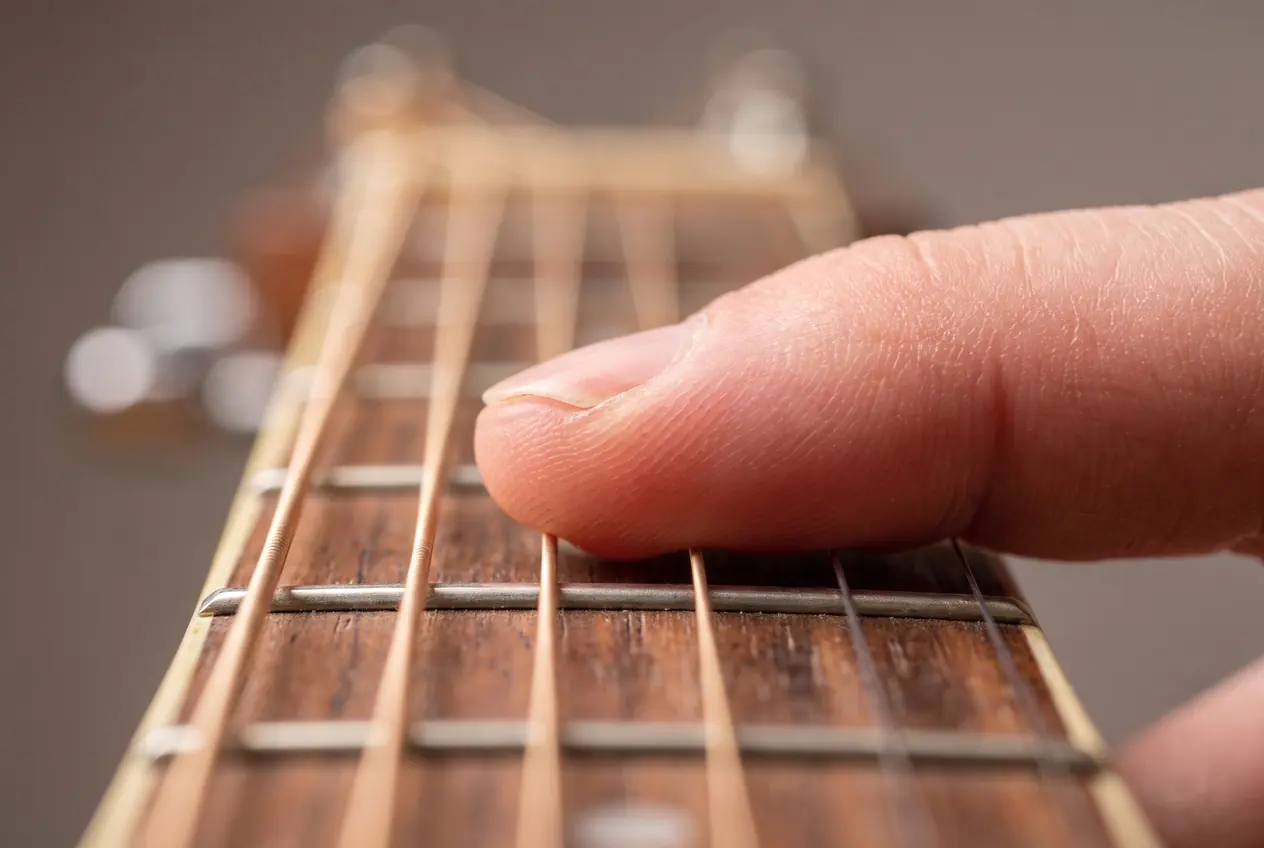
Normal: fingertips
Your left-hand fingertips sting and tingle, and show string marks. For a few days you feel it even when you pick things up. This is the skin of your fingertips hardening from friction with the strings: calluses forming.
- Acoustic (steel strings, high tension) hurts most, and electric comes next.
- Classical (nylon) hurts least.
- On bass the strings are thick, so it's less your fingertips and more your whole hand that aches.
How long does it last?
If you play every day, the soreness is worst in the first one to two weeks, and it usually takes about a month for your fingertips to toughen. It varies from person to person, and some people never build much callus however long they play (Yousician).
| When | Fingertips | What to do |
|---|---|---|
| Week 1 | The most painful. They sting, and string marks stay for a while | 10–15 minutes, two or three times a day. No long sessions in one go |
| Week 2 | The pain drops noticeably | Lengthen each session little by little |
| Weeks 3–4 | Fingertips turn firm and smooth (calluses) | Keep playing daily. They fade if you stop |
Not normal: wrist, elbow, back of the hand, shoulder
An aching inner wrist, pain on the outside of the elbow, a stiff back of the hand or numb fingers point to a posture problem or overuse. Unlike calluses, this doesn't pass — it builds up. Stop right away and find the cause.
| Symptom | Verdict | Cause | What to do |
|---|---|---|---|
| Stinging, tingling fingertips | Normal | Calluses forming | Keep at it, short and often. About a month |
| Fingertip blisters | Within normal | Playing too long in one go | Don't pop it; keep it covered. Rest that finger |
| Pain or numbness on the inside of the wrist | Stop | Bent wrist (holding the guitar too flat), thumb position | Angle the neck up and put your thumb at the center of the back of the neck. Check in a mirror |
| Pain on the outside of the elbow | Stop | Forcing barre chords, squeezing the neck | Position instead of force. Get a setup to lower the action |
| Stiff back of the hand or finger joints | Caution | Spreading the fingers too far, not enough stretching | Loosen up your hands before practice; save wide-stretch chords for later |
| Shoulder, neck | Caution | Posture, strap height, guitar weight | Adjust the strap, fix your sitting posture, use a lighter guitar (LP-styles are heavy) |
How to press with less pain
- Use the very tips. Press with the tip of the finger, not the middle of the fleshy pad. That is also where calluses form. Barre chords are the only exception.
- Right behind the fret, only as hard as needed. Use the least pressure that gives a clean note. Pressing hard hurts and pushes the notes sharp.
- Keep your nails short. Long fretting-hand nails stop you from standing your fingertips up, so you end up pressing with the pad.
- Warm up first, shake out in between. Loosen your fingers and wrists before you start, and shake out your hands during breaks (Yousician).
How to get through the first three weeks
- Short, often, every day. Several 10–15 minute sessions beat one long one. Don't take more than two days off. Without regular playing, calluses fade again.
- Lighter strings. Switching to 009 on electric or 011 (extra light) on acoustic lowers the tension and makes the first month much easier. You can move to heavier strings later.
- Setup. High strings make you press harder, which doubles the pain. A shop setup costs $50–110.
- Don't play right after washing your hands. Water-softened fingertips hurt more, and the calluses peel.
- Don't pick at calluses. Even if the skin on your fingertips starts to peel, leave it. Pick it off and you start over.
If you get a blister
Don't pop it. Cover it loosely with a bandage and keep it clean. Most blisters heal on their own in one to two weeks (American Academy of Dermatology). Meanwhile, don't fret with that finger; practice right-hand rhythm or just form chord shapes.
Common questions
Does soaking fingertips in rubbing alcohol or vinegar speed things up?
It circulates as an anecdote from a famous guitarist, but the evidence is weak. In the end, calluses only come from playing every day (Yousician).
Do heavier strings build calluses faster?
Heavier strings and higher action do build calluses faster, but early on they hurt so much that you skip practice. In your first month, light strings and a setup that let you play every day work better.
Does a classical guitar not hurt?
Nylon strings hurt less, but your fingertips still go through the same toughening process.
When to see a doctor. If numbness or tingling in your fingers (especially the fingertips) continues after you stop practicing, wakes you up at night, or makes it hard to grip things, it may be a sign of carpal tunnel syndrome. Get it checked without delay (Cleveland Clinic). Burning pain on the outside of the elbow that spreads into the forearm may be tennis elbow from repeated gripping, and the first treatment is rest (Cleveland Clinic). If wrist or elbow pain lasts more than a week, see an orthopedic doctor.
Sources: Yousician, Guitar calluses and finger pain · Cleveland Clinic, Carpal Tunnel Syndrome · Cleveland Clinic, Tennis Elbow · American Academy of Dermatology, How to prevent and treat blisters. This article is not a substitute for a medical diagnosis.