Home›Learn›Beginner roadmap

Beginner roadmap — months 0–6

Most people who quit don't lack talent. They lack an order to follow. Each stage lists what to do, common mistakes, and when to move on, with the differences between the four instruments noted at the end. The rule: 15 minutes a day, every day.

One rule. 15 minutes every day beats an hour twice a week. Calluses and muscle memory build with frequency. Take 3 days off and your calluses soften.

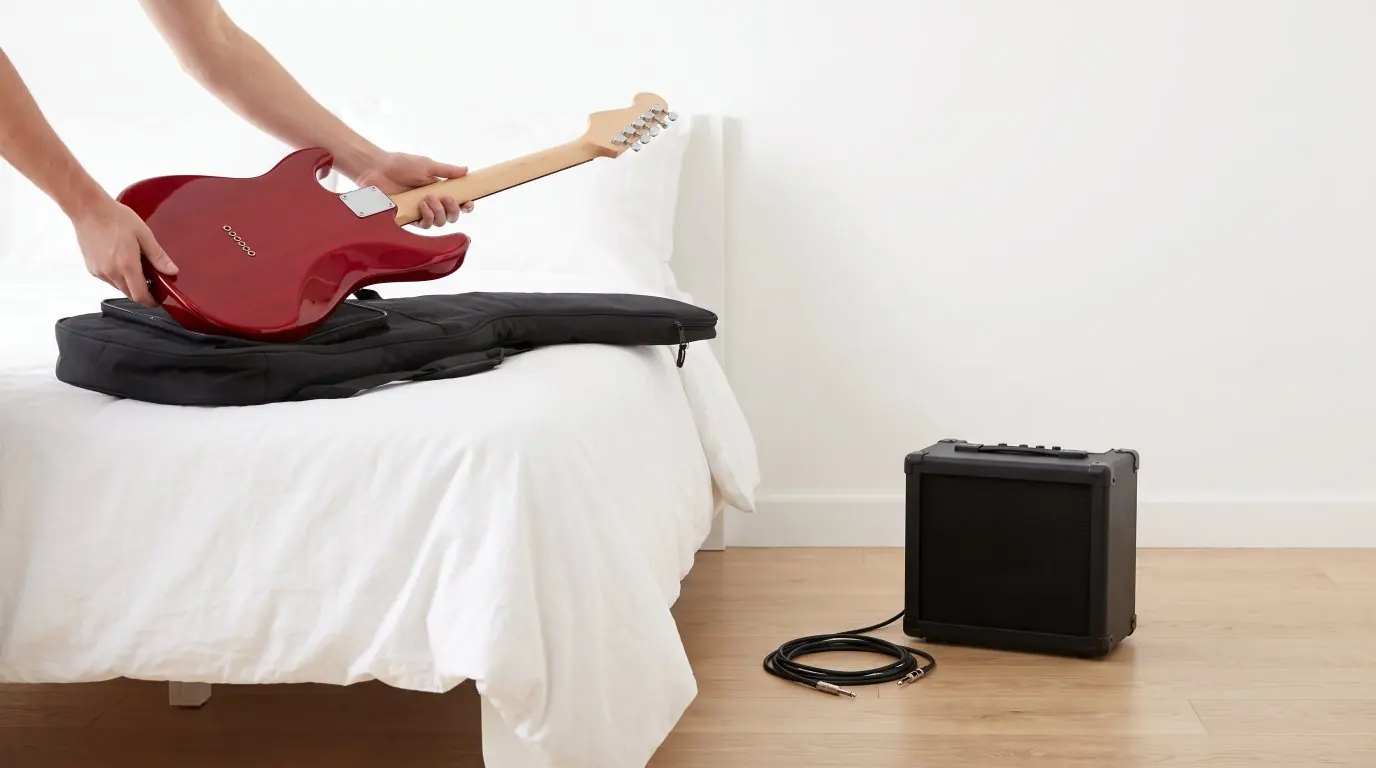
Hands taking a new guitar out of its case
Weeks 0–1

1Get ready — make it sound right

  • Get your gear. The instrument, plus (for electric and bass) an amp and cable, and a clip-on tuner. Missing something? See Find my guitar and the gear guide.
  • Hook-up order. Amp volume at 0 → plug in the cable → power on → raise the volume slowly. Following this order keeps a loud pop from damaging the speaker.
  • Standard tuning. From the thickest string: E · A · D · G · B · E (bass: E · A · D · G). Clip the tuner onto the headstock and go one string at a time. No tuner yet? Tune right now with the First Guitar tuner. How to tune
  • Learn the string names. String 6 (the thickest) is E, and string 1 (the thinnest) is also E: "E-A-D-G-B-E."
  • Sitting and holding the pick. Rest the guitar's waist on your right thigh, with the neck tilted slightly up. Hold the pick between the pad of your thumb and the side of your index finger. See posture
  • Get a setup. New or used, one shop setup ($50–110). With the right string height, pressing gets half as hard.

Common mistakes. Practicing out of tune, deciding "I just can't play," and quitting. Turning the amp gain all the way up so you can't hear what you're playing. Use a clean tone for the first 2 weeks.

AcousticSetup matters even more. An acoustic with high action is truly hard to play. Buy a capo along with it.
ClassicalStart with a footstool and the guitar on your left thigh. New nylon strings keep stretching for over a week, so tune every day.
BassMake sure it's a bass amp (never a guitar amp). Set the strap so the bass sits at the same height sitting and standing.
Ready for the next stage when you can tune in under 30 seconds and name the strings.

You can pick up from here on the home page (saved on this device only).
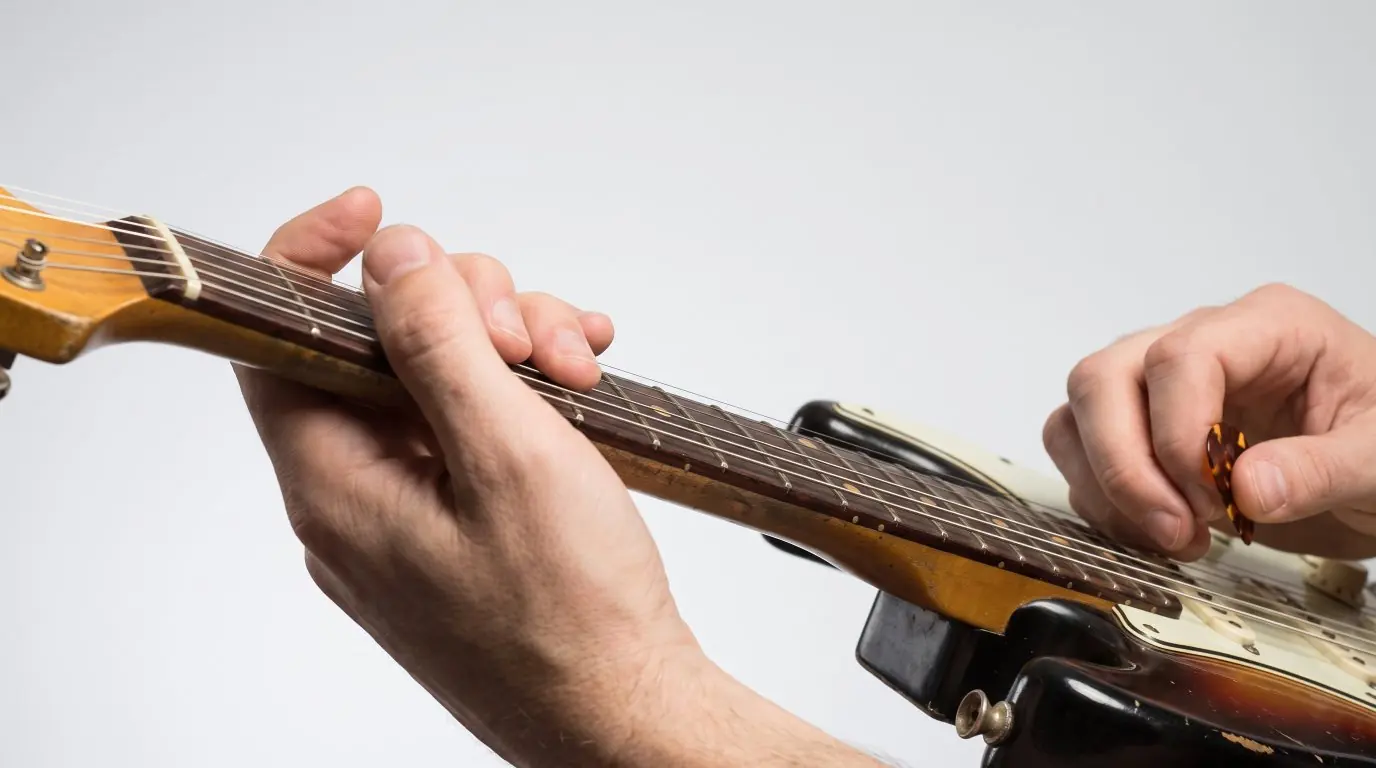
A left hand fretting a first chord
Weeks 2–5

2First chords — shaping your hand

  • Week 2 · Power chords. E5 · A5 · D5. Make one hand shape and just move it along the frets. Try a chugging sound with palm muting. Downstrokes only, metronome at 60.
  • Week 3 · Four open chords. Em · Am · E · A. Grab a chord and let go, over and over for 60 seconds (one-minute chord change). Press just behind the fret with your fingertips standing up.
  • Week 4 · Three more open chords. D · G · C. Change practice: Em→Am→D→G. One up-down strumming pattern (down-down-up-up-down-up).
  • Week 5 · A four-chord progression. Loop G–D–Em–C. This one progression lets you accompany hundreds of songs. 10 chord diagrams
  • Finger care. Sore fingertips are normal, and calluses form in 2–3 weeks. If you get a blister, rest a day, but don't take more than two days off.

Common mistakes. Pressing on top of the fret and getting buzz (press just behind it). Fingers touching the next string and muting it (stand your fingertips up). Putting off change practice until every chord is perfect (changes come first).

AcousticFingertip pain is worst around week 3. Start with Em, Am, C, G and D instead of power chords. This is when you learn to use a capo to match a song's key.
ClassicalArpeggios rather than strummed chords. Play the same chord shape one string at a time in p-i-m-a order (thumb, index, middle, ring). Start with tirando (free stroke).
BassRoot notes in steady eighths instead of chords. Play the four roots of G–D–Em–C, alternating two fingers. Muting the strings you're not playing is half of this stage. Root position chart
Ready for the next stage when you can change through G–D–Em–C at metronome 60 without stopping (bass: moving between the roots).

You can pick up from here on the home page (saved on this device only).
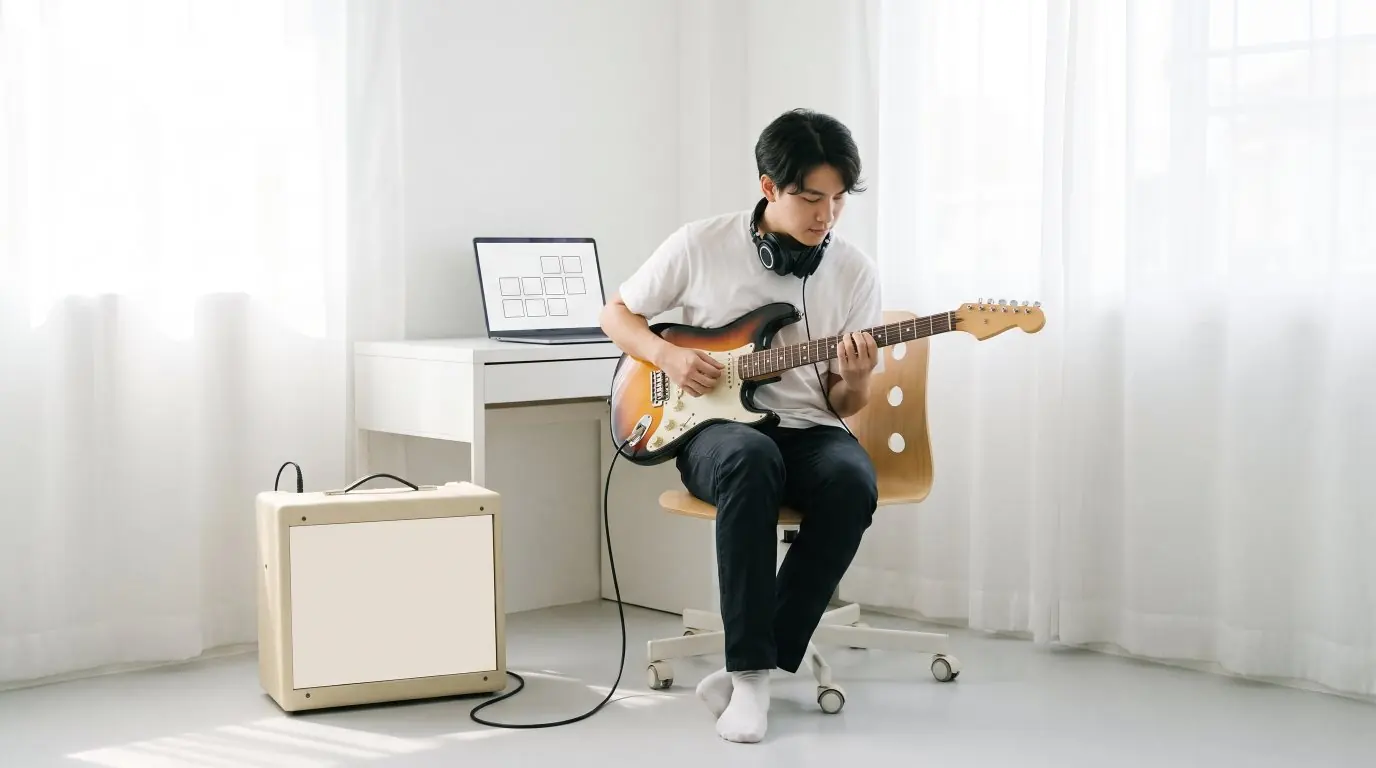
Practicing a first song at home, plugged into an amp
Weeks 6–12

3First song — start to finish

  • Pick a song. 3–4 chords and a slow tempo. Starting with a riff is fine too.
    • Electric · riffs: Deep Purple 'Smoke on the Water', The White Stripes 'Seven Nation Army' / Power chords: Green Day 'Boulevard of Broken Dreams', Crying Nut 'Mal Dalija'
    • Acoustic · open chords: Oasis 'Wonderwall', DAY6 'You Were Beautiful', JANNABI 'For Lovers Who Hesitate', Kim Kwang-seok 'Becoming Dust'
    • Classical: 'Romance' (Romance Anónimo), Tárrega 'Lágrima', 'Greensleeves'
    • Bass: The White Stripes 'Seven Nation Army', Queen 'Another One Bites the Dust', Michael Jackson 'Billie Jean'
  • How. Cut the song into 4-bar chunks and go slow → 80% of full speed → 100%. Play along with the original recording. YouTube's 0.75x playback speed is handy.
  • Record yourself. Record on your phone and listen back. The moment you hear yourself, you get a level better.
  • No effects yet. Use only the drive and reverb built into your amp. Pedals come in stage 4.
  • Your first string change. Around 3 months in, the sound gets dull. For the first change, watch and learn at a music store, or go slowly with a video.

Common mistake. Starting with your favorite song even though it's hard. Keep that song as a goal, and finish an easy song first so you know what getting all the way through feels like.

Ready for the next stage when you've played one song start to finish without stopping and recorded it on your phone.

You can pick up from here on the home page (saved on this device only).
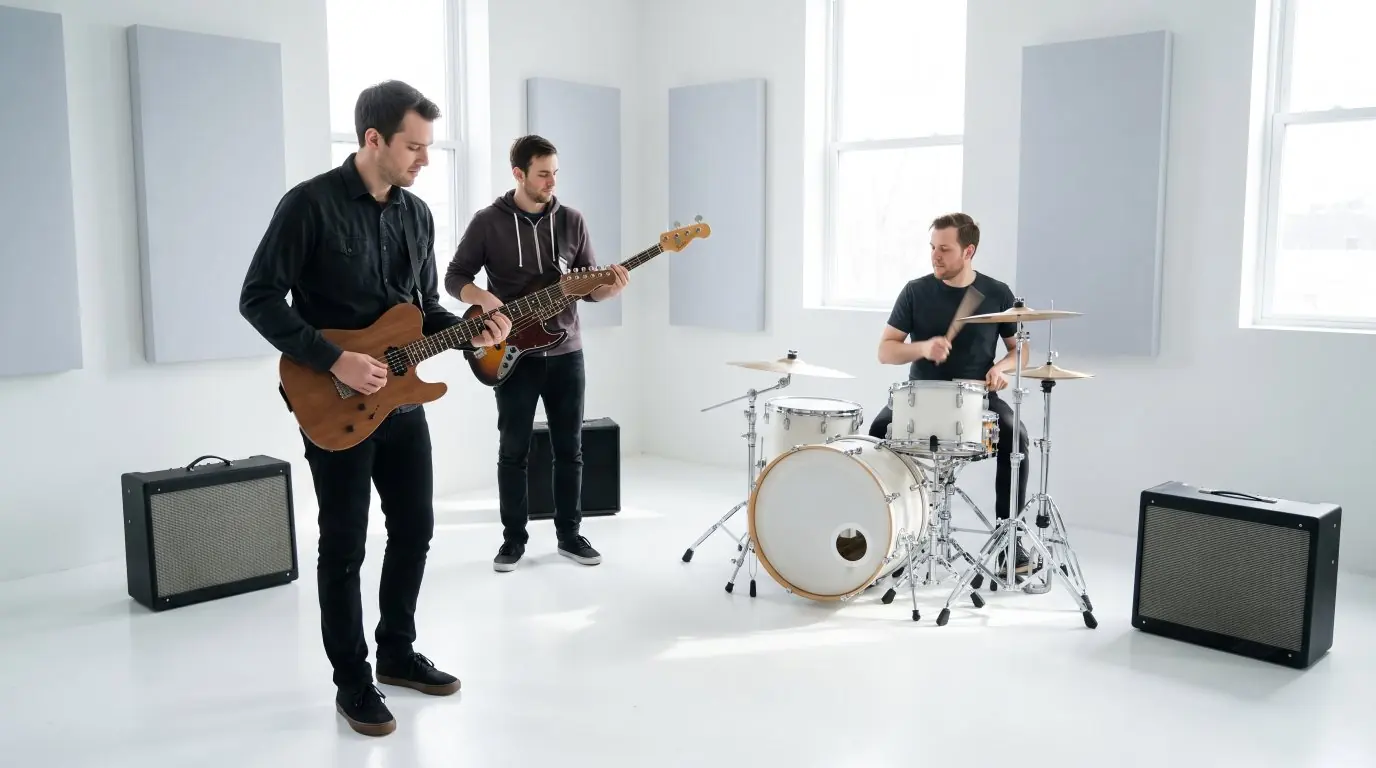
Playing with a band in a rehearsal room
Months 4–6

4Branch out — barre chords, first solo, playing with others

  • Barre chords. F and Bm. Press all six strings at once with your index finger. It usually takes 4–8 weeks, and everyone hits a wall here at least once. Rolling your index finger slightly onto its bony side takes less effort.
  • Pentatonic box 1. Memorize just one shape. Add bends and vibrato and you have your first solo.
  • Five rhythm patterns. Eighth-note downstrokes, alternating eighths, basic sixteenths, shuffle, palm-muted eighths.
  • One effect. Just one overdrive or delay pedal. If you buy a multi-effects unit, use only 3 presets.
  • Play with others. Band-member ads, local groups, ensemble classes at a contemporary music school. Rehearsal rooms rent by the hour. It's fine if you can't play well at first. Just keep the beat.
  • Recording. An audio interface plus a free DAW (GarageBand, Cakewalk, Reaper trial). Try posting one cover video.
  • Thinking about the next guitar. This is where everyone starts browsing new guitars. Give your current one a full year. Buy once you know what you're missing, and you won't regret it.
AcousticBarre chords F and Bm, a first fingerstyle song, using a capo, a taste of open tunings.
ClassicalApoyando (rest stroke), scales, short pieces (Carcassi and Sor études). From this point, bad posture sets in easily without a teacher.
BassSlap basics (thumb and index), basic walking bass, one compressor. For bass, playing with others is the practice, so find a band at this stage.

When to find a teacher. What gets you stuck here (barre chords, rhythm, posture) is hard to fix with videos. Around month 4 is the most efficient time to check your level and find a teacher.

6 months done when you can play one song with barre chords (bass: one song's bass line) and have played with someone else at least once. Get this far and you're past the stretch where 90% of beginners quit.

You can pick up from here on the home page (saved on this device only).