The F chord: how to get it in 4 weeks, step by step
Once you can play seven open chords, everyone stalls at F. It's your first barre chord, with a single index finger pressing all six strings. Strength won't get you there; doing things in the right order will. It usually takes 4–8 weeks, and that's normal.
0. Suspect the guitar first
If the strings sit high at the 1st fret (the nut slots aren't cut deep enough), the F chord is hard even for pros. If the 1st fret feels much harder to press than the others, it's a setup problem. Before you start, get a setup with a nut adjustment at a music store ($50–110). What a setup is and where to get one
1. Roll your index finger
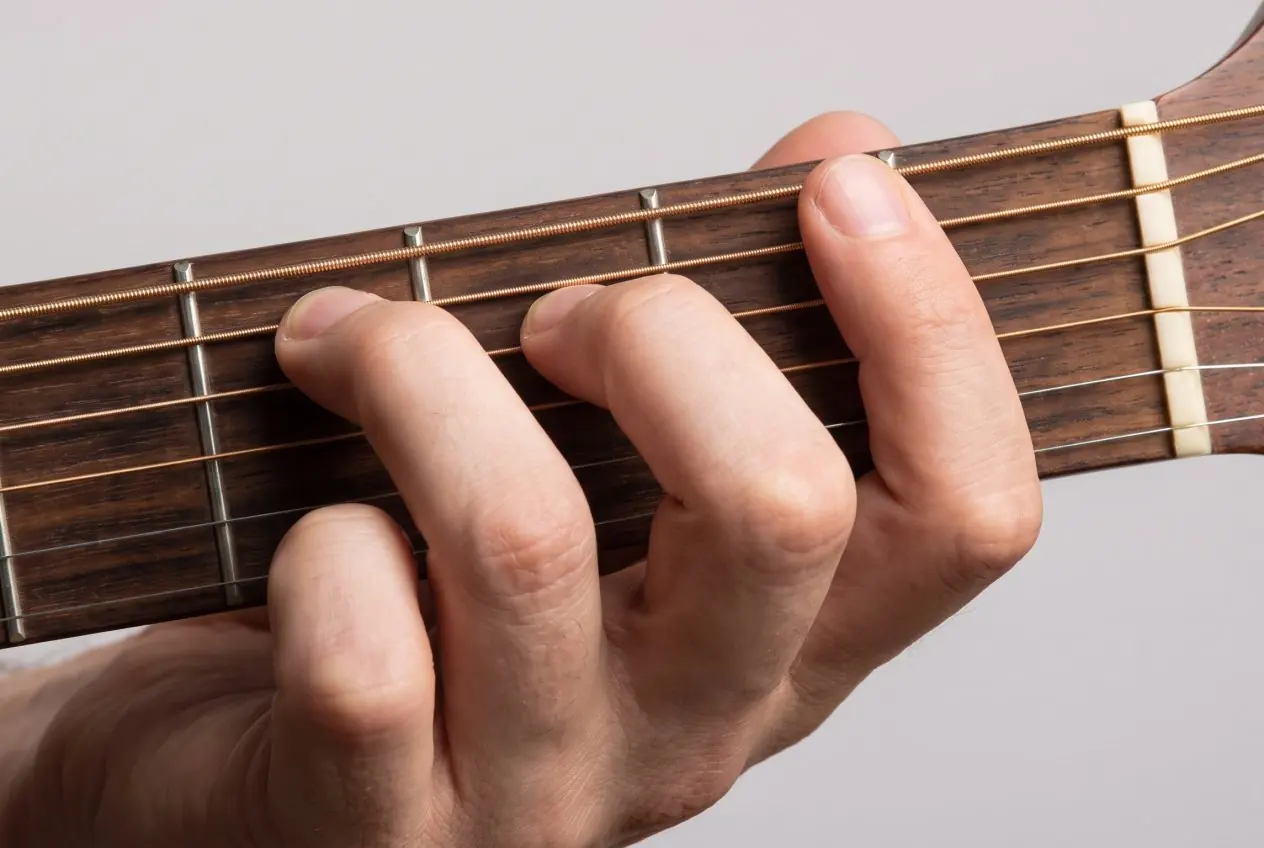
Press with the pad of your index finger (the fingerprint side) and the strings sink into the creases at your knuckles and go dead. Instead, roll the finger slightly toward your thumb and press with its hard, bony side. And place it just behind the 1st fret, not on top of it.
2. Start with three strings, not six
At first, only strings 1, 2 and 6 need to ring. Your middle, ring and pinky fingers cover the other three (3, 4 and 5), so your index finger is responsible for just three strings. Knowing that cuts the effort in half.
For an even easier stepping stone, there's the 'mini F' (strings 1–4 only, with the index finger on strings 1 and 2).
3. Thumb and elbow
Put your thumb in the middle of the back of the neck, opposite your index finger. Keep your elbow slightly in against your body and push your wrist forward, and your index finger lies flat on the fingerboard. Holding the neck angled up a little keeps your wrist from bending as much.
4. Position, not pressure
If a string doesn't ring, don't press harder — find out which string it is. Pick the strings one at a time to find the dead one, then move only the finger covering it by 1–2mm. Pressing hard wears your hand out in three minutes and pushes the notes sharp.
5. One-minute chord changes
Take your E chord shape, move it up one fret and lay your index finger across: that's F. So your first exercise is E ↔ F. Count how many times you can switch back and forth in one minute, and write it down every day. Next comes C ↔ F, then G ↔ F. The change comes first; a perfect grip comes later.
6. Give yourself a way out in songs
Don't stop playing songs that have an F in them. Until you've got it, swap in Fmaj7 (1st string open, so your index finger presses one string less) and play the song all the way through. Finishing songs does more to keep you from quitting than nailing the F chord.
| Symptom | Cause | Fix |
|---|---|---|
| Strings 1 and 2 are dead | Strings caught in the creases of the index finger | Roll the index finger onto its bony side, just behind the 1st fret |
| Hand wears out in three minutes | Pressing with force | Find just the dead strings and adjust position; check thumb position |
| Wrist hurts | Bent wrist | Angle the neck up, elbow in against your body |
| Other chords are fine, but the 1st fret is unusually hard | Nut too high | Setup |
4–8 weeks. With 15 minutes of E↔F changes every day, most people get it within that time. If it still isn't working after 8 weeks, it's time for someone to look at your posture. A posture check or two with a teacher is the most efficient money you can spend.