GearElectric
Do beginners need effects? Start with what's in your amp
Bottom line first: you don't need effects from the start.
- The modeling and desktop amps that many beginners buy these days often have drive, delay and reverb built in.
- And if you don't have an amp, a pedal alone won't make any sound.
It's not too late to buy effects one at a time once it's clear what you're missing.
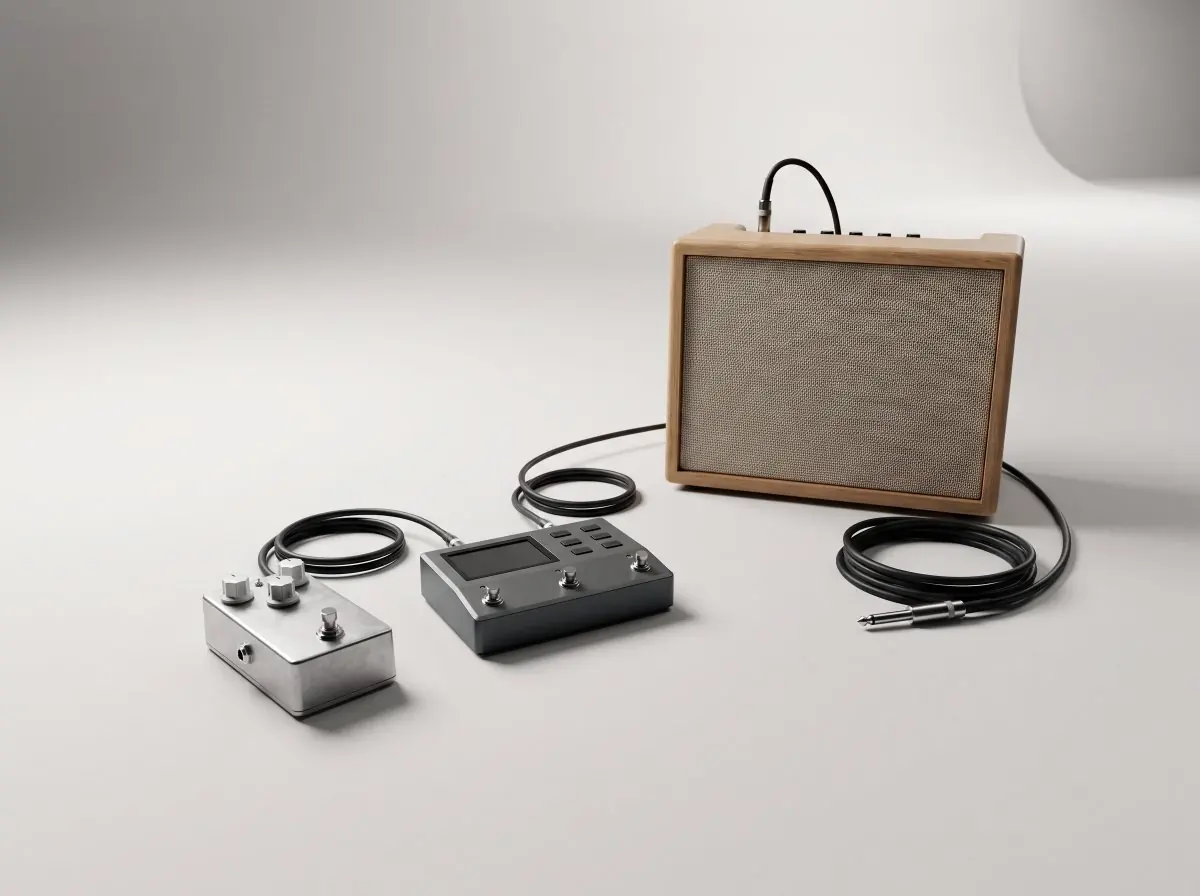
Two things to check before you buy
- Does your amp already have effects? Modeling amps that imitate many amp sounds (Boss Katana, Positive Grid Spark, Yamaha THR, Fender Mustang, etc.) mostly have effects built in. Try the built-in effects first.
- Do you have an amp? A pedal goes between the guitar and the amp, so a pedal on its own makes no sound. To start without an amp, look at a multi-effects unit you can plug headphones into, or a headphone amp.
When you'll need one
| When | Effect | Examples (USD) |
|---|---|---|
| You've started playing in a band or live | Tuner pedal — the first pedal on a pedalboard. Tunes accurately even in a loud room | Korg Pitchblack X $83–109 · Boss TU-3 $109 |
| Your amp's drive is weak, and you play blues, rock or pop | Overdrive — breaks up more when you dig in, cleans up when you play softly | Boss SD-1 $69 · Ibanez TS9 / TS Mini $79–99 |
| You play hard rock or metal, but your amp has no strong drive | Distortion | Boss DS-1 $69 · Boss MT-2 $111 |
| You don't know which effects you need, or you're starting without an amp | Multi-effects — try them all for the price of two or three pedals | Zoom G1X Four $99–119 |
| Your amp has no reverb | Reverb — makes the dry sound of headphones or a small room more natural | Electro-Harmonix Holy Grail Nano $137 |
If you only play at home, a clip-on tuner ($16–22) or First Guitar's browser tuner is enough instead of a tuner pedal.
Things beginners often get wrong
- Compressor — a pedal that evens out volume, but the effect is hard to hear, so beginners struggle to notice a difference. Not recommended as a first pedal.
- Distortion gain — the higher you turn it, the more noise you get and the muddier your chords sound. On a small practice amp it easily turns harsh.
- Powering a digital delay — it draws a lot of current, so a 9V battery won't last long. Count the cost of a power adapter too.
- The multi-effects trap — with so many menus, it's easy to spend all your practice time building sounds. Cheaper models can run fewer effects at once.
- Looper — a pedal that repeats what you just played. It's often named as useful for building your sense of timing when you practice alone. Modeling amps and multi-effects often already have one.
Only the effects your amp and music need
In Choose effects, answer which amp you have and what music you play. If what you need is already built in, it tells you to use that first and shows only the types you actually need.
In Choose effects, answer which amp you have and what music you play. If what you need is already built in, it tells you to use that first and shows only the types you actually need.