First bass amp and strings — five ways bass gear differs from guitar
Bass looks a lot like guitar, so it's easy to assume the gear is the same. Five things are different, and the first one is about money.
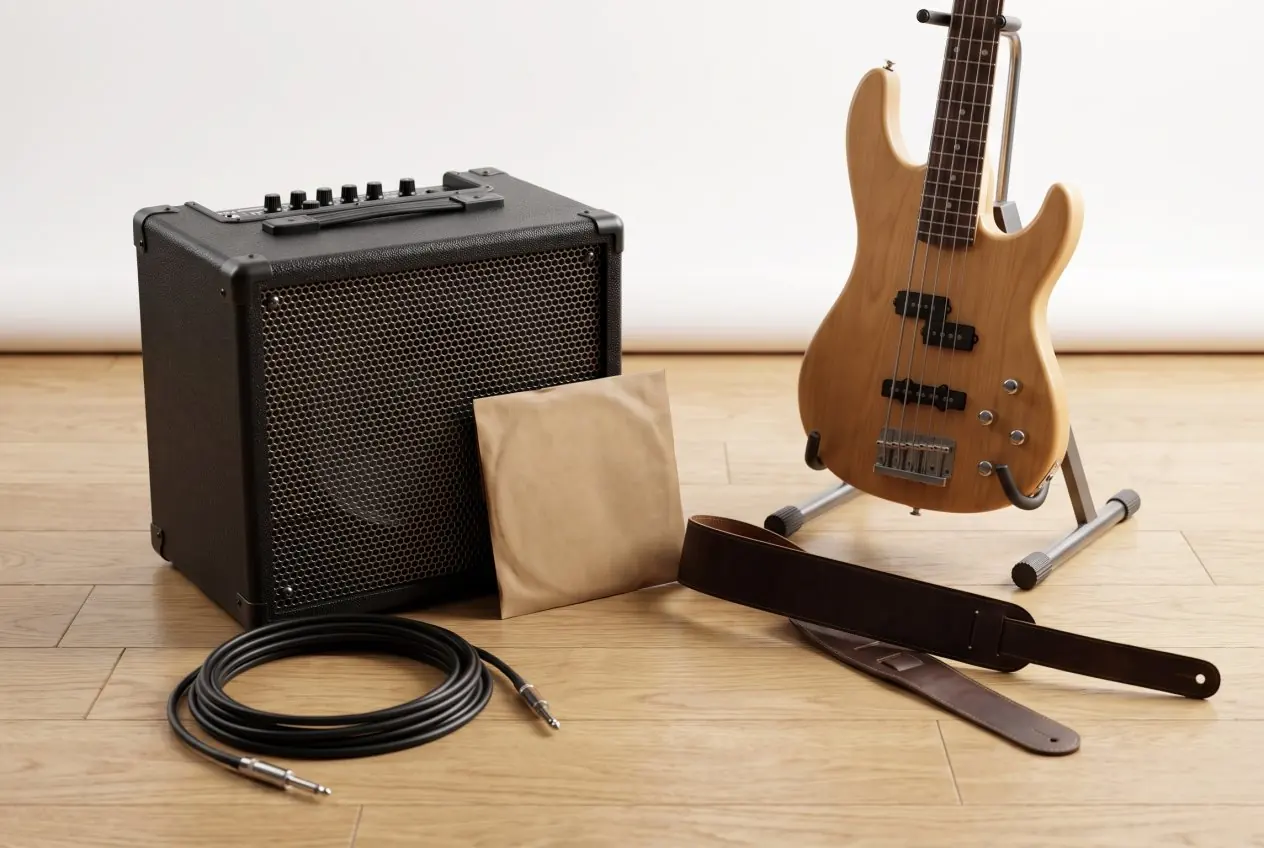
1. The amp has to be a bass amp
Plugging a bass into a guitar amp won't break it right away at low volume. But the low end pushes the speaker cone too far, causing a tearing sound, and over time it damages the speaker. It won't sound right either.
- Home: a 15–40W bass combo — Fender Rumble 15/25, Ampeg Rocket Bass RB-108, Hartke HD15 ($100–200)
- Band: 100W or more with a 12–15-inch speaker — Rumble 100/200, Ampeg RB-115 ($390–630)
- Can't make noise where you live: starting with a bass headphone amp, the Vox amPlug 3 Bass ($56–60), is fine too.
2. The tuner has to read low notes
Cheap clip-on tuners struggle to pick up the bass's 4th string (E). Choose a tuner with a "bass mode" or a wide chromatic range. If it still won't register, one trick is to tune using the 12th-fret harmonic.
3. Strings cost more, but last longer
The standard gauge is 045–105 (4-string). A set costs $22–25, two to three times a guitar set, but lasts longer: change it every 4–6 months.
- Roundwound: bright, the standard. Start with these.
- Flatwound: duller, easier on the hands, and lasts much longer.
You wind the strings at the headstock differently from a guitar, so the first time it's faster to learn by watching at a music store.
4. Go wide on the strap, and lock it on
A bass weighs 4–5kg. Stand for an hour with a thin strap and your shoulder quits first. Use a strap at least 7cm wide, padded if possible, plus strap locks from the start. Wearing the strap even when seated keeps the headstock from dipping, which is easier on your left hand.
5. For recording, going direct without an amp is standard
For bass, the standard is to plug straight into an audio interface (DI) to record. You don't mic the amp as guitarists do. On stage, too, a DI box sends you straight to the mixer.
So if cover videos or recording are your goal, an interface may come before an amp (Focusrite Scarlett Solo, Audient EVO 4 · $160–180).
| Item | Guitar | Bass |
|---|---|---|
| Amp | Guitar amp $50–370 | Bass amp $100–650 (no guitar amps) |
| Strings | 009–010, $8–11, every 2–3 months | 045–105, $22–25, every 4–6 months |
| Tuner | Any clip-on | Reads low notes (bass mode) |
| Strap | Basic | Wide padded + strap locks |
| Recording | Mic the amp or use a sim | Straight into an interface (DI) |
| Case | Guitar case | Bass case (different length) |
First pedal: a compressor. If a guitarist's first pedal is overdrive, a bassist's is a compressor. It evens out volume swings, instantly tidying up a beginner's sound when finger strength is uneven. But that's for six months from now.