ChoosingAcoustic
Choosing a beginner acoustic — dreadnought, OM, GA, mini: models by body shape
An acoustic needs no amp, so the guitar's price is your budget (the cheapest complete kit is $258–355). The first thing a beginner should decide isn't the brand but the body shape.
The shape decides how loud it is, how it feels to hold, and what it's good for.
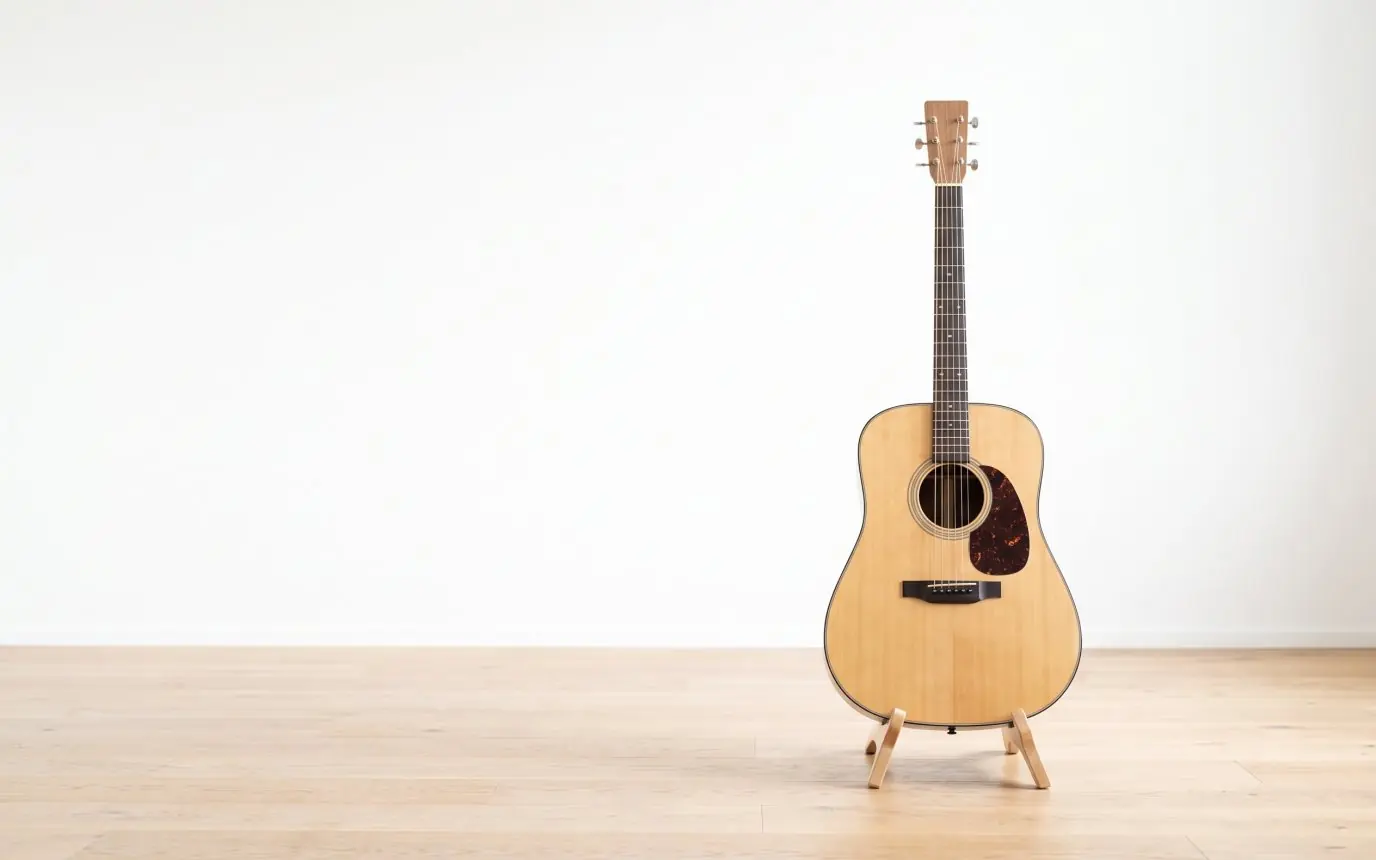
Four body shapes: what's different
| Shape | What it looks like | Good for |
|---|---|---|
| Dreadnought | The most common large body | Accompanying singing, strumming. Loud, with rich lows |
| OM / concert | Mid-size body with a narrow waist | Comfortable to play seated and well balanced, so it handles both fingerstyle and accompaniment |
| GA / cutaway EA | Mid-size + cutaway + pickup | Gigs, recording, busking. Plugs straight into an amp |
| Mini / travel | A small acoustic with a smaller body and shorter scale | Camping, travel, small rooms, kids. Quieter sound |
Dreadnought
- Yamaha F310 / F370 ($229) — often treated as the benchmark beginner acoustic. The top is laminate, so the tone won't open up much over time, but with a setup it does the job. The F370 has body binding, so its finish is a little neater.
- Cort Earth70 — a solid top (solid Sitka spruce) at the entry level. The AD810 ($209) in the same slot is laminate, top included.
- One step up: Yamaha FG800 / FG830 ($259–449) · Cort Earth100 ($259) · Fender CD-60S ($229) — all have a solid top with laminate back and sides.
OM / concert
- Cort AF510 ($229) — a concert size with a 43mm nut, comfortable for beginner hands. The official spec sheet doesn't say 'solid,' so it's best not to treat it as a solid-wood guitar.
- Yamaha FS800 ($259–279) — costs a little more, but the top is solid.
- One step up: Yamaha FS830 ($449, laminate rosewood back and sides) · Fender CC-60S ($229, solid top).
GA / cutaway EA — if you plan to perform
A cutaway, where the lower part of the body is scooped out, lets your hand reach the high frets easily. The pickup (the "EA" part) lets you plug straight into an amp or speaker. Models in this price range often have a tuner built into the preamp, so you don't need a separate one.
- Yamaha FX370C ($281–282) — a cutaway with a piezo pickup. Laminate top and back.
- Yamaha APX600 ($389) — the thin body is easy to hold, and with a 3-band EQ and a tuner it's ready for the stage. The trade-off: the deep low-end resonance acoustics are known for is weaker.
- One step up: Takamine GD30CE ($559–699) — an acoustic-electric with a solid top.
Mini / travel
- Yamaha JR2 ($209) — 3/4 size. Light and affordable, good for kids or travel, but it has no pickup.
- One step up: Yamaha CSF1M ($549, solid top · pickup) · Martin LX1 ($449, synthetic back and sides that resist temperature and humidity · no pickup).
So which should you choose?
| If you | Shape |
|---|---|
| Want to strum chords while you sing | Dreadnought |
| Will play seated in your room and want to try fingerstyle | OM / concert |
| Plan to busk, perform or record | GA / cutaway EA |
| Want a guitar for camping or travel, or for a child | Mini |
| Don't know yet | OM is the safest choice (handles both accompaniment and fingerstyle) |
What to sort out before shape
- Setup. An acoustic with high strings is truly hard to play. Plenty of people quit after skipping a $50–110 setup. Details are in the setup guide.
- If the top is solid, humidity. Solid wood can crack from winter heating, so you need a gig bag and a hygrometer. If you're not confident you can manage humidity, laminate is actually the safer choice.
- The word 'Solid'. To tell whether the wood is solid, check whether the maker's spec sheet says 'Solid'. If it only says 'Spruce · Mahogany', it's often laminate.
Laminate vs. solid wood. Why prices differ within the same shape, and when you actually notice the difference, is covered in Laminate vs. solid-top acoustic guitars: what's actually different?
Start with the shape and models that fit your answers
Answer questions on budget, music, where you'll play and hand size to get a body shape, models, and a total budget that includes the small extras you need.
Answer questions on budget, music, where you'll play and hand size to get a body shape, models, and a total budget that includes the small extras you need.